The Science of Human Alertness
Health • Safety • Performance • Readiness
Exploring the biological and cognitive foundations of vigilance, readiness, and high performance in a 24-hour world.
Alertness is a core human capability that determines how effectively people perceive, decide, and act. It reflects the interaction of sleep, circadian rhythms, brain function, health, and environment.
From daily productivity to mission-critical operations, alertness shapes safety, learning, reaction time, and human performance. Advances in neuroscience, sleep science, and biometrics are redefining how alertness is understood, measured, and enhanced.
Alertness reflects neural readiness but is influenced by physical state, exertion, and recovery.
The Human Fatigue-Alertness Continuum
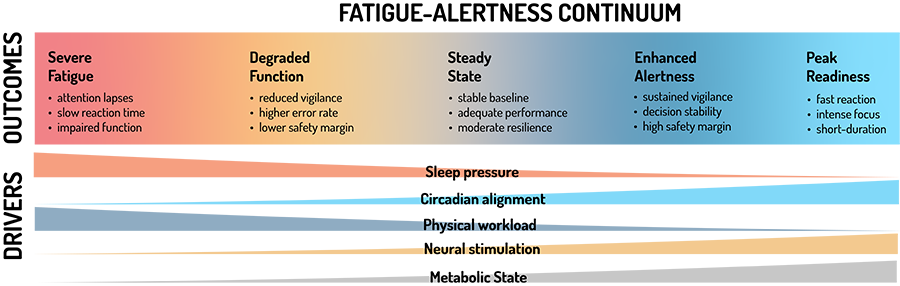
Biological, cognitive, and physical states influencing readiness, performance, and risk
Alertness and Fatigue: A Dynamic Continuum
Alertness is not constant — it rises and falls throughout the day in response to sleep history, circadian timing, workload, and environmental conditions.
Physical fatigue can reduce alertness by increasing physiological strain and recovery demand
These dynamics influence:
- vigilance and sustained attention
- reaction speed
- cognitive clarity
- decision quality
- physical coordination
Scientific foundations
Brain and neurochemistry
Alertness is regulated by neural systems governing arousal, attention, and wakefulness, influenced by sleep cycles, light exposure, and circadian biology.Cognitive readiness
Levels of alertness directly affect learning, problem-solving, situational awareness, and executive decision-making.Health and wellbeing
Alertness reflects underlying sleep quality, recovery, and physiological resilience.Measurement
Emerging methods include reaction-time testing, wearable monitoring, neurocognitive assessment, and real-time readiness indicators.Performance applications
Alertness plays a defining role across many domains:
- healthcare and clinical performance
- aviation and transportation safety
- military readiness
- elite sports and physical performance
- knowledge work, and productivity
- education and learning
- human-technology interaction
Technology and the future of readiness
Wearables, neurotechnology, and predictive analytics are enabling continuous insight into alertness and cognitive readiness.
These tools are shaping applications in personal performance, workplace safety, healthcare, transportation, and human-machine collaboration.
Research and operational ecosystem
Scientific and operational applications of alertness and fatigue research are implemented globally across healthcare, transportation, and industrial sectors by organizations including CIRCADIAN®, https://circadian.com/ and other leaders in sleep, circadian, and human performance science.
Alertness is not simply wakefulness — it is the foundation of human readiness, performance, and safety in an always-on world.
For research collaborations or strategic applications related to fatigue and alertness science: inquiries@alertness.com